Thursday, 11 June 2015

Reverend W. Awdry

Wilbert Vere Awdry was born on the 15th June 1911 was a railway enthusiast and children's author. He was better known as the Reverend W. Awdry, he was the creator of Thomas the Tank Engine, the main character in his famous Railway Series which had its first broadcast on the ITV network in 1984.


Thomas the Tank Engine is a small fictional steam train in The Railway Series books by the Reverend Wilbert Awdry and his son, Christopher. He became the most popular character in the series, and is the main character in the accompanying television series, Thomas & Friends.
homas the Tank Engine and Friends" is "live action model animation. To create the characters of Thomas, Henry, Percy, Gordon, and the gang, model-makers start with Marklin model train chassis and then modify the bodies to represent the various characters. Under a train's body shell lies the mechanism for moving the engine's eyes -- up, down, sideways, or 'round and 'round -- by radio control. In addition, there is a diaphragm pump and smoke unit to blow the specially formulated "smoke.".


Each character has its own basic face, which is first sculpted in clay. Then a rubber mold is made, and several copies are cast in a mixture of resin and auto-body filler. Each replica is reworked into different expressions, from which a final silicone casting is taken. The characters' faces are changed between shooting sequences and are held in place with nothing more than double-sided adhesive tape. Thomas alone has more than 40 faces cast for him, while the other engines have five or six each.
Thomas the Tank engine and friends is now created completely by CGI.

Thomas the Tank Engine

Robert Zemickis

Who Framed Roger Rabbit is a 1988 fantasy-comedy film directed by Robert Zemeckisproduced by Steven Spielberg and based on Gary K. Wolf's novel Who Censored Roger Rabbit?. The film combines the use of traditional animation and live action, with elements of film noir.


VistaVision cameras installed with motion control technology were used to accommodate the split screen photography of animation and live action. Mime artists, puppeteers, mannequins and robotic arms were commonly used during filming to help the actors interact with "open air".


Who Framed Roger Rabbit (1988)

Wednesday, 10 June 2015

Oliver Postgate and Peter Firman


Richard Oliver Postgate was born on the 12th April 1925, he was an English animator, puppeteer and writer. Peter Arthur Firmin was born on the 11 December 1928 and is an English artist and puppet maker. 
Between them they were the creators and writers of some of Britain's most popular children's television programmes. 

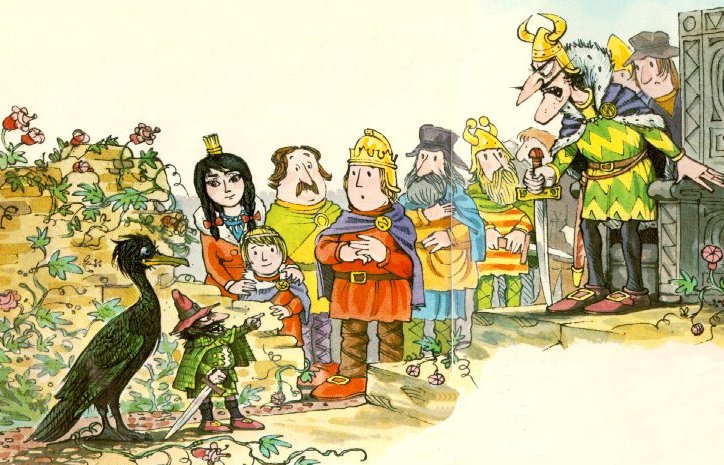
Postgate and Firmin mainly focused on stop motion animations; which then caused Noggin the Nog to be created, the first episode was first aired in 1959 and premiered its last episode in 1972. Due to the lack in animation technology The Saga of Noggin the Nog was draw completely by hand.


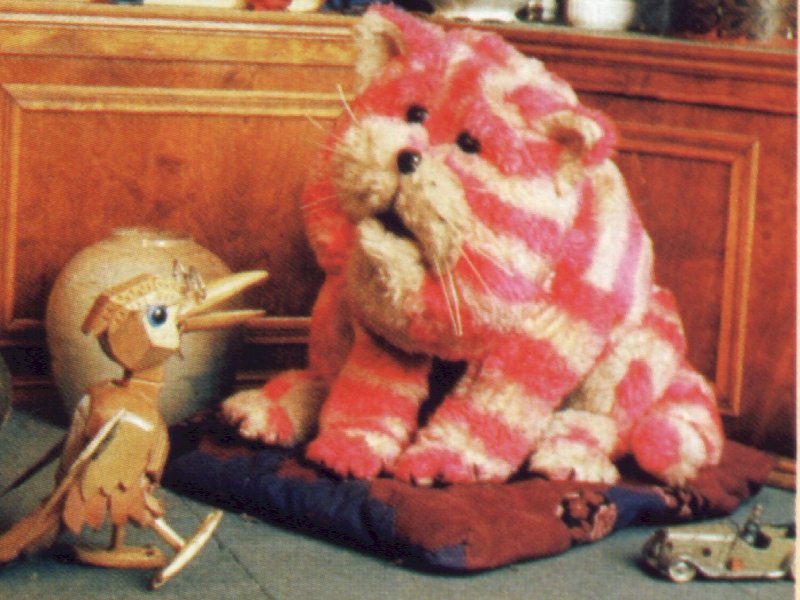
In 1974 Postgate and Firman created Bagpuss; bagpuss was a stop motion animation, due to the improvements in technology Bagpuss was in colour.


The Saga of Noggin the Nog - King of the Nogs

Bagpuss - Ship in a bottle

Monday, 1 June 2015

Walt Disney


Walt Disney – Steamboat Willie


Walt Disney was born on December 5, 1901 in Chicago Illinois. Walt Disney was an American motion-picture and television producer and showman, famous as a pioneer of cartoon films and as the creator of Disneyland. Founder of Disney, Early creations were Mickey Mouse, Donald Duck and goofy. Steamboat Willie was a 1928 American animated short film it was the debut of Mickey Mouse in 1928 it was the first animation in sync with sound; the old Mickey Mouse had basic animation, time limitation, it was in black and white, no voices and was hand drawn. 


Steamboat Willie (1928)

Pat Sullivan


Pat Sullivan

Australian cartoonist, pioneer animated and a film producer. He is best known for the first Felix the cat silent cartoons. After years or refusing to turn Felix the cat to sound, he finally agreed to and let them add sound to an already created animation. Feline follies (1919) - the Felix film.

Felix the cat was originally a drawn cartoon, each frame was drawn our separately. After drawings are cleaned up they are then photographed on an animation camera, usually on black and white stock. Felix the cat originally started out as a magazine. Pat Sullivan changed the way cartoon were seen. They also sold Felix the cat merchandise. Felix the cat was one of the longest running cartoons there has ever been. 


Feline Follies (1919)

Max Fleischer

Max Fleischer - Out of the Inkwell

Max Fleischer was born 1883 in Vienna, from an early age he had an interest in mechanics. He invented the Rotoscope with his brother in 1915, it is an incredible device which helps to produce realistic animation. He is known for bringing characters such as Betty Boop, Popeye and Superman to the movie screen and was responsible for other technological innovations.


Fleischer’s studio was a major operation in New York under the support of Paramount Studios. When the three-color Technicolor process became available, Paramount vetoed it based on their concerns with economic balance, giving Disney the opportunity to acquire its exclusivity for four years. Two years later, Paramount approved colour production for Fleischer. These colour cartoons were augmented with a Fleischer-patented 3D background effect called “The Stereoptical Process”, this was before Disney’s Multiplane.

Fleischer invented a concept to simplify the process of animating movement by tracing frames of live action film. Extensive use of this technique was made in the Out of the Inkwell series. It starred Koko the Clown and Fitz the dog..


The positives are that it was a quick animation, KoKo the Clown had human movement, and the animation is very impressive for something that was made 94 years ago; there is also diagetic sound which helps to make KoKo’s movements more comical, all in all it was a fantastic use of the rotoscope. The rotoscope bought animation and live action together. However it was very repetitive as it was the same movements just at different locations, the quality was poor as the quality decreased due to changing from animation to live actions.

Out of the Inkwell - Modelling (1921)

Winsor McCay

Winsor McCay – Gertie The Dinosaur

Winsor McCay used an animation technique called ‘key-frame animation’ which allows the animation to move from one point, to the other smoothly. McCay also used the ‘split-system’ that he said he created to carefully lay out and time an entire sequence. By the 1930’s, the ‘split-system’ was known as the breakdown drawing or the passing position.

He then drew his subject midway between his split and an extreme, and continued drawing in this manner until the sequence was finished. McCay’s discussion of drawing for animation ends at this point (Richard Williams The Animators Survival Kit barely begins at this point) and he moves on to discuss his career, achievements and the future of animation.


 Winsor McCay was born in 1867 in Canada. McCay had an interest in drawing from the moment he could hold a pen. In 1888 McCay went to work at the National Printing Company of Chicago to illustrate posters mainly for circuses. In 1890 he moved to Cincinnati, creating advertising posters for the Kohl and Middleton Dime Museum. McCay also picked up additional work as a billboard painter.


In 1903 he produced sort of experimental comic strip entitled "Tales of The Jungle Imps by Felix Fiddle", based on poems by George Chester.


In this period newspaper comic strips were becoming very popular so McCay began experimenting with his own original strips.
While working for Hearst, McCay began experimenting with the idea of using animated pictures as part of his Vaudeville act. His first attempt was made using the popular characters from the "Little Nemo" strip. It was a huge success. He continued his experiments with animation and created "How a Mosquito Operates", which was also a success. Finally, in 1914 McCay created "Gertie The Dinosaur". Gertie was an instant success and is the first original character developed solely for the animated cartoon and not based on a pre-existing comic strip.
Gertie was made into a feature film with a live-action prologue and epilogue and shown around the world. McCay began working purely on animated films. The next film released in 1918 was "The Sinking Of The Lusitania”.


Gertie the Dinosaur - Gertie on tour (1921)

Tuesday, 21 April 2015

Advertising - Task 3


Similarities:

  • They both promote the protection for teeth.
  • They both state that the paste help to whitens your teeth.

Differences:

  • The new one has music
    • The voiceover isn’t monotone so this help keep the viewer’s attention.
    •  It is in colour instead of black and white.
    • The new advert is also half the time of the old one, a shorter advert would also help to keep the audience’s attention unlike a longer advert.
    • It also does not explain what the toothpaste does in a lot of detail.

  • The old advert is very simplistic, it has no creativity to it; it’s telling you what the toothpaste does in a very boring manner.

    • The shots of the toothpaste seem to be pictures put together to make the advert have the illusion that the toothpaste is moving of things are moving around
    • The only moving spot is when the woman puts the toothpaste on her toothbrush and brushes her teeth.

  • The old advert is boring and dull whereas the new one is energetic.
  • The new advert does not incorporate humans in the video as much as the old advert does, you only see a brief shot of someone’s hand.
  • The old advert also has no catchphrase and no text

Presentation


Mind map


Tuesday, 27 January 2015

Advertising - Task 2

Advertising – Task 2 (30.1.2)
Advertisers use a variety of techniques to get us to buy goods or services. Some of them are listed below. Can you fill in the gaps and find an example of the persuasive technique used?

Type of persuasive technique
Link to an advert which uses this technique
The Anecdote: Personal experience or story which is sold to us as proof.
In this link a woman named Caroline McKinnon had her laser eye surgery and you see her before the surgery with her glasses on and she’s expressing how happy she’s been with the company’s (Opitmax) services. She is then shown without her glasses and she is stating how clear her eyesight is.
Adjective: Crisp, fresh, healthy, nutritious, etc.
The adjective in this advert is extra crunchy.
Repetition: Key points, positives about the product, themes etc.
https://www.youtube.com/watch?v=R7gpmvcGIT8 In the advert they repeat the companies phone number several times throughout the song and they describe their services as ‘Directory heaven’.
Statistics: Often presented as factually accurate but sometimes they are a bit dubious.
 This advert tells us what powerful formulas are used however to your average person the formulas represented don’t mean anything to them.
Facts:  A statement that is true and can be proven.
This advert tells you the statistics for how many children are abused and these facts can be proven – however as this is an old advert the facts are no longer accurate.


Tuesday, 6 January 2015

Advertising - Task 1

Advertising – Task 1 (30.1.1.)

1. Explain what TV advertising is.
TV advertising is marketing your product on television to your target market. Advertisers desire to provide messages to people who are interested in their products or services. For example you would broadcast a games advert on a children’s television channel and those children will use pester power to get their parents to buy the product for them. Adults would see the advert and it might appeal to them and make them want to buy the products for friends, family, or a partner; especially if the advert is relevant to the time of year (Christmas).

2. View three different contemporary TV adverts and list three key characteristics of them. 
  • Love
  • Friendship
  • Sharing/Giving

Tuesday, 2 December 2014

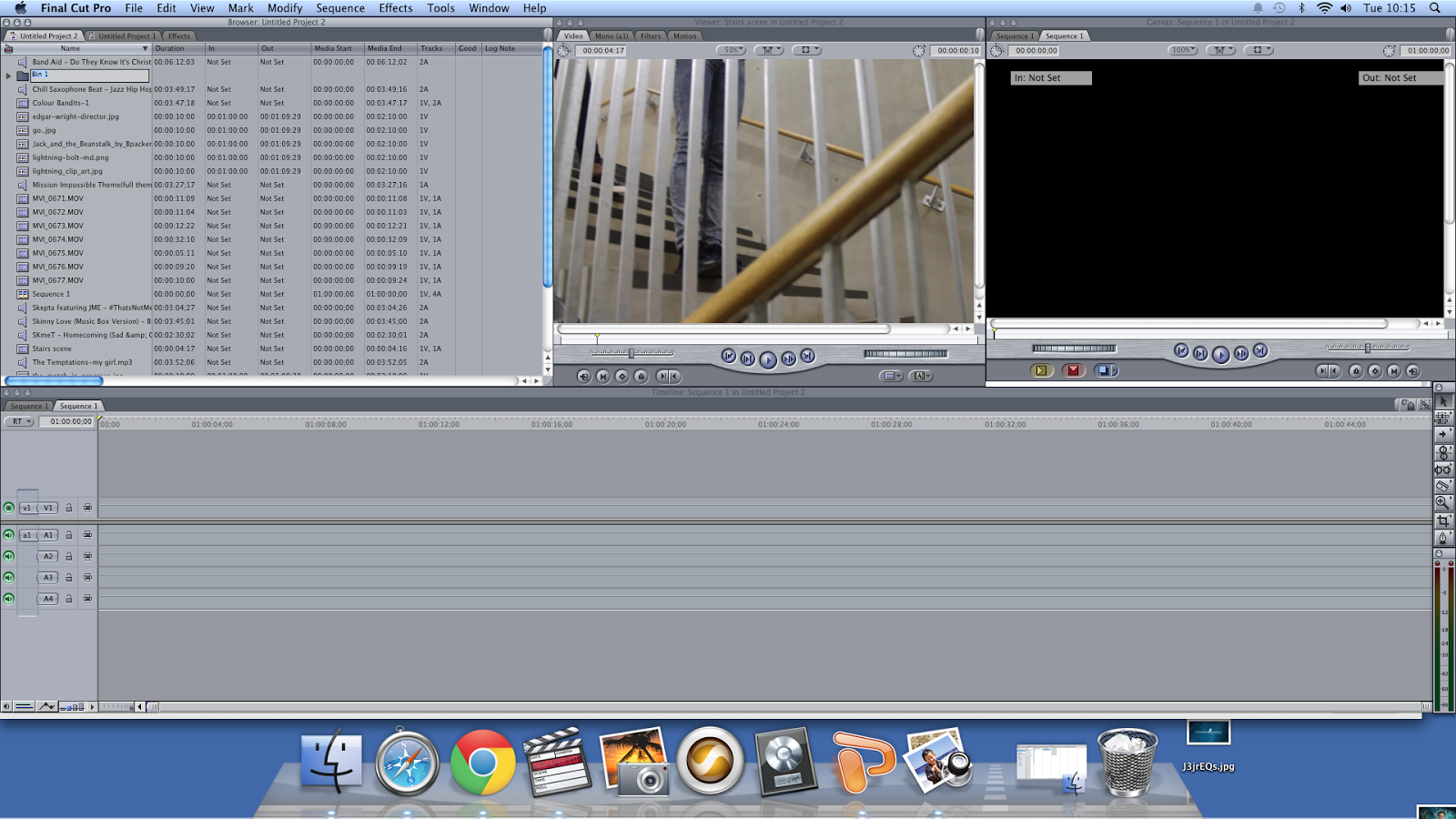
6 ways to organise your clips

6 ways to organise your clips
1) rename your clips to something relevant
 to rename the clips you need double click on the files original name
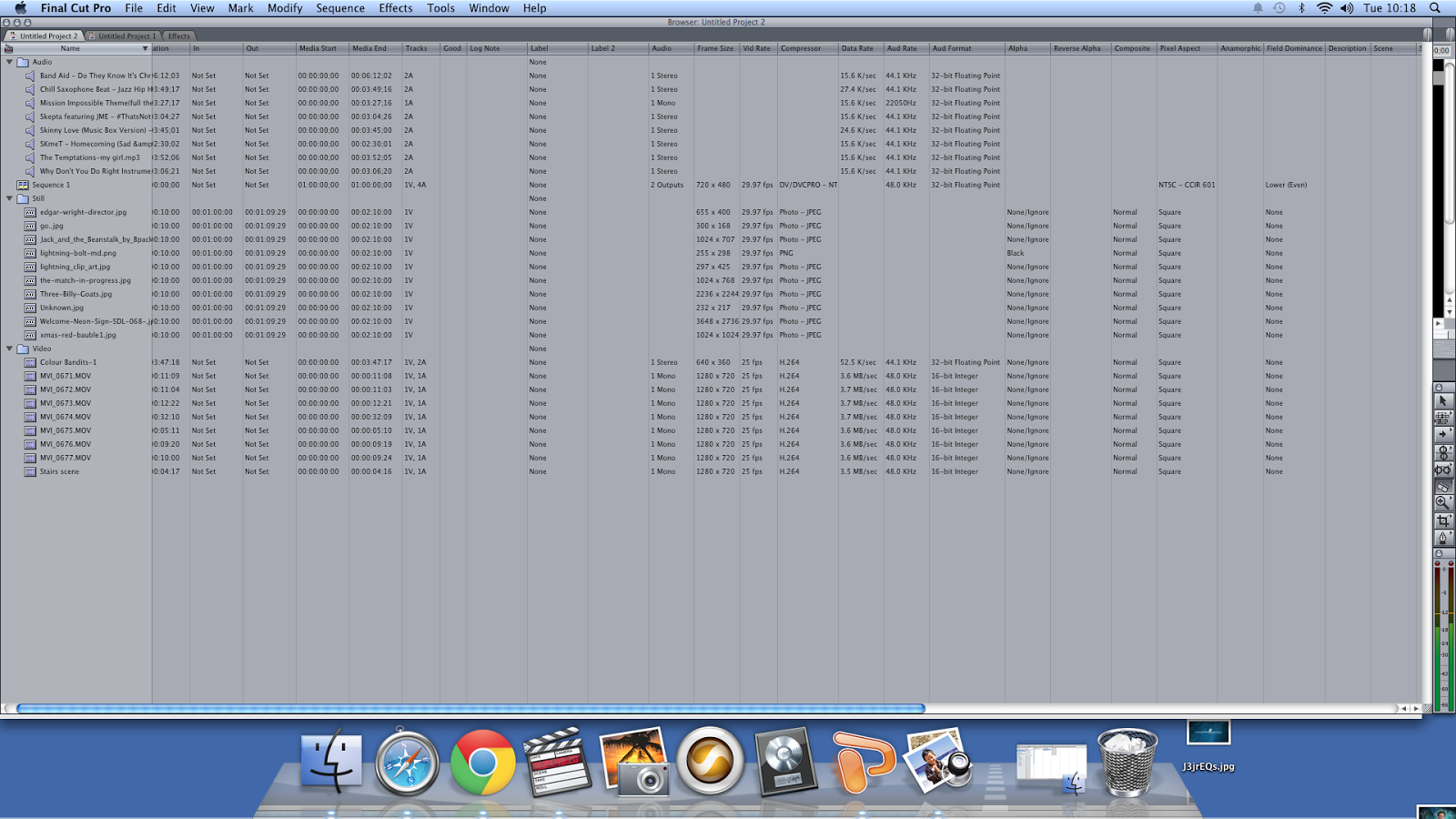
2) Make Separate folders (bins) by pressing cmd+b or right click and new bin

3) Reorganise columns, Move the good column near the clips
4) You can organise your folders into bins named audio, stills and videos
5)you can colour code different shots by right clicking on a shot then left click on label

6) Mark the file as good

How to set up a project in final cut pro


To set up a project in final cut pro..
first you need to open a new project 
then you need to create a new project folder in HD2, you can name this what ever you want! 
 after creating the project folder you need to go to final cut pro then system settings
once pressed you need to set where you want to save all your files for this project. You will save it in the folder you just created
 after you've set where your files are going to be saved you need to import the footage for the project
 you will need to create a folder names footage and place all the footage needed in that folder
 once your footage has been added press cmd and A to highlight all of your footage, once highlighted press import to add it to the final cut pro project
after you've imported your footage you're done and you can continue to edit on your timeline.

Tuesday, 11 November 2014

The history and development of editing
By Amari Rae Shepherd Scott

In this essay I shall be discussing the beginning of the cinema, and how editing has developed over the past century, I will use my three chosen films to make a comparison between the editing techniques used in a clip from each film which will further increase evidence of the evolution of editing. I will be doing this by using an original film and a remake of the original film. The original film and the remake film I am using is ‘The Karate Kid’ 1984 and 2010, there is a 26 year gap between when the films were made which I think is a long enough time gap for there to be significant improvements in the editing techniques used. I will also be using Edwin S. Porter’s silent film ‘The Great Train Robbery’ made in 1903; I decided to use this film, as it was the first film to ever be edited which is why I think it is a brilliant film to use to help represent the development of editing.

The Great Train Robbery is a classic Western film with four thieves who steal a train and rob its passengers of their valuable possessions and then make their grand escape only to be killed in a shootout by a group sent after them. As I mentioned previously ‘The Great Train Robbery’ was the first edited movie, which was a great milestone for the future of the cinema. The only editing techniques used in The Great Train Robbery are cuts and wide shots; this is due to the lack of technology in the early 1900s, however by using the cut technique Porter was able to bridge together the occurrence of a whole day and compress it into an eleven minute film. All the shots in The Great Train Robbery are over 30 seconds long as Porter did not know what length to make the shots, as he didn’t know how the audience would react. No matter how pessimistic Edison and the Lumiere Brothers were about the future of the cinema – especially considering how Auguste Lumiere thought “The cinema is an invention without a future” – as no one would want to pay to see something that they can see in their daily lives for free however after Edwin Porter created the first edited movie it was said that “The invention of the cinema is the equivalent to the invention of flight” Porter proved that you can cut two shots that aren’t related to each other together to create an interesting story. There is no sound at all in The Great Train Robbery as technology was not advanced enough to add it to the film, the entire film is neither diagetic nor non-diagetic.

The Karate Kid 1984, directed by John G. Avildsen is not based off of a book; screenwriter Robert Mark Kamen scripted it. I will be using the Halloween scene where Daniel (the karate kid) is getting beaten up by a group of boys that do karate and Mr. Miyagi stands up for Daniel and defeats the bullies. The first shot is a establishing shot showing the surroundings, this is used often at the beginning of a scene to show what the surrounding area looks like and the correlation between people or objects in that area. then it becomes a mid-shot and cuts out the other characters to make Daniel running the main focus then it zooms out to become a wide shot again so you can see that the bullies are getting closer to Daniel, after this it shows a mid-shot of Daniel to show his facial expression, this helps to portray to the audience Daniel’s main emotion at that moment which is fear, after this mid-shot it becomes a wide shot again which shows you the bullies pulling Daniel off of a fence he was trying to climb to get away from them. There are several mid-shots from different angles whilst Daniel is getting abused; when Mr. Miyagi jumps in to protect Daniel different camera angles are used. During the entire scene there are no transitions just cuts from shot to shot. During the beginning of the scene there is non -diagetic sound that eventually beginnings to fade out into another non-diagetic sound, throughout the whole scene the non- diagetic sound is merged with diagetic sound.
The Karate Kid 2010 is a remake of the 1984 karate kid, there are many similarities in the plot of the film such as Mr Han and Mr Miyagi are both maintenance men, and see Dre/Daniel getting bullied and stand up for them and then decide to teach them martial arts. At the beginning of the scene we see the main bully Cheng about to beat up Dre (Jaden Smith) as a slow motion close up, in the next couple of shots eyeline match is used showing no mercy in Cheng’s eyes. An unknown hand is seen blocking Cheng’s punch towards Dre in a close up and you only see both of their hands. There are several close ups of Dre on the floor clenching his chest, by using a close up on Dre the audience can see his emotions at that moment in time and makes the audience somewhat feel his pain and become a part of him and makes them feel involved in the film. There are constant different mid-shots in the scene to show their leg movements whilst fighting. Elliptical editing is used to cut out any unnecessary actions for example the bullies dropping to the floor or getting back up, this makes the scene shorter due to the shots that were cut out. There are jump cuts between all the shots, this helps make it more dramatic instead of using a dissolve transition which is more gentle and would not suit the scene. Throughout the scene there is non-diagetic sound merged with diagetic sound, the non-diagetic sound changed during the scene as the main fighting begins, the non-diagetic sound is louder than the diagetic sound for most of the scene.

In conclusion there has been a significant improvements in the techniques of editing, sound has now been added to films to help suit the scene, new methods of editing have been used to help make the audience feel a part of the film, the transition between shots are much smoother than they used to be, so much that you don’t even noticed when the shot has changed, eyeline matching helps you know what the character is looking at. Elliptical editing has been a big help to the improvement to the development of editing as the audience no longer has to watch the entire action of the character – for example we will see the character get in their car and then get out of their car instead of previously we may have had to watch them start up the car and begin to drive – by using elliptical editing screen time is much shorter. Overall the development of editing has improved significantly from the help of computer editing.

Tuesday, 7 October 2014

The importance of the five shot rule

What is sequential shooting?
Sequences are the fundamental building rocks of any good bit of television

What are the five shots you need for the five shot rule in sequential shooting?
A sequence generally consists of a close up on the hands, a close up on the face, a wide shot, an over the shoulder shot and then another shot from a different angle (low shot, high shot etc.)

Why shoot in sequences?
If you film in sequences you will get usable shots in the order given.